

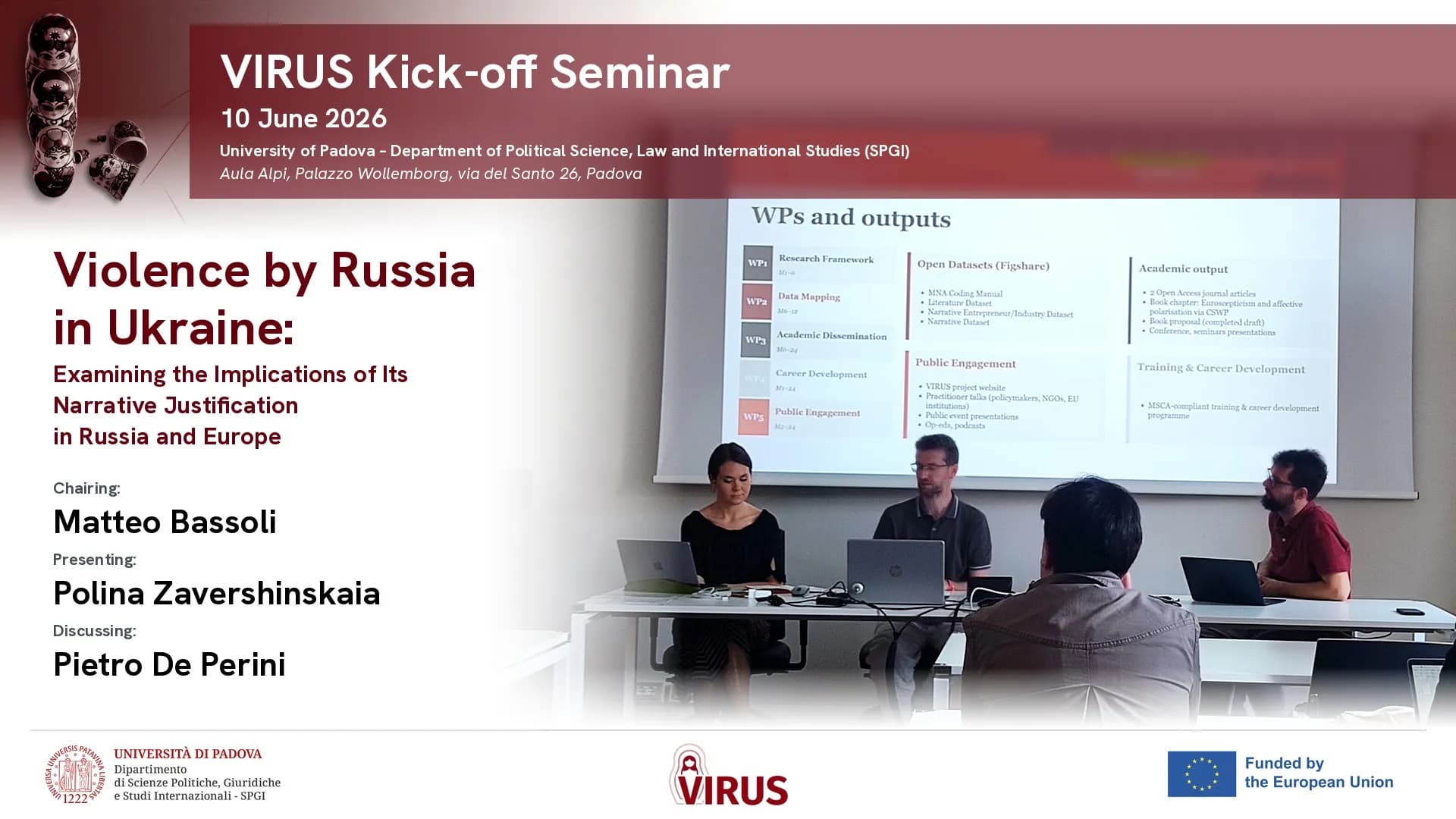
On 10 June 2026, the project “VIRUS – Violence by Russia in Ukraine: Examining the Implications of Its Narrative Justification in Russia and Europe” was launched with a hybrid kick-off seminar at the Department of Political Science, Law and International Studies (SPGI) of the University of Padova, as part of the Seminari di Scienza Politica series.
Featuring a talk by Polina Zavershinskaia, chaired by Matteo Bassoli, and followed by a discussion led by Pietro de Perini, the seminar brought together students, early-career researchers, senior scholars, and members of the wider public to discuss the implications of the narrative justification of the Russian invasion in Russia and Europe.
About VIRUS
VIRUS is a two-year project funded under the Horizon Europe programme (Marie Skłodowska-Curie Actions, MSCA). The funding was awarded in 2025 under the HORIZON-TMA-MSCA-PF-EF – MSCA Postdoctoral Fellowships (European Fellowships). The project runs from 1 June 2026 to 31 May 2028 at SPGI of the University of Padova, and will be conducted by Polina Zavershinskaia under the supervision of Matteo Bassoli.
VIRUS will examine how the Russian invasion of Ukraine is portrayed as necessary, moral, or even sacred by illiberal actors in Russia and their counterparts in Italy, Germany, and Austria. It will analyse how these narratives contribute to the justification, normalisation, and potential escalation of violence. Beyond its research component, the project will provide analytical tools and contextual knowledge tailored to Russia, Germany, Austria, and Italy, enabling stakeholders, practitioners, and the broader public to recognise and address harmful narratives and Russian disinformation.
Violence justification and its impact in the age of disinformation
Since Russia’s illiberal turn gradually intensified during Vladimir Putin's presidency, the Kremlin has consistently framed both its domestic and international violent interventions as efforts to safeguard national sovereignty. The invasion of Ukraine represents the most recent manifestation of this trajectory, being portrayed within Russia as a necessary, moral, and even sacred act: a difficult but justified decision taken by the Kremlin in defence of Russian citizens and sovereignty and an extraordinary expression of Russian bravery.
Importantly, this sacralisation—rather than mere normalisation or banalisation—has been echoed, reframed, and subtly reinforced by illiberal actors worldwide in ways that resonate with their domestic audiences. Consequently, the influence of Russian disinformation, and the broader justification of its actions—at times even praising Russia as a model of strong leadership and sovereignty—are evident at local, national, European, and global levels.
Within EU member states, domestic illiberal actors normalise narratives that justify Russian aggression, contributing to political polarisation and the erosion of democratic norms. In Germany, Austria, and Italy, the illiberal parliamentary parties with longstanding ties to Russia such as Alternative for Germany (AfD), the Freedom Party of Austria (FPÖ), and the League (Lega) have adopted an antagonistic discourse that, on the one hand, portrays Russian aggression as a last resort to protect its sovereignty and, on the other, frames EU and domestic support for Ukraine’s self-defence as a dangerous escalation. In some cases, this rhetoric has been accompanied by concrete actions, including instances of sabotage and other forms of political violence. An illustrative example is the Identitarian Movement’s Aktion Solidarität (Solidarity Action), which staged a symbolic “reopening” of the Nord Stream 2 gas pipeline campaign after the pipeline’s closure following Russia’s invasion of Ukraine.
Reflecting these national dynamics, at the EU level, European cohesion is challenged by both direct Russian influence and illiberal actors within member states and EU institutions (such as Eurosceptic groups and MEPs in the European Parliament). These actors contest integration, undermine inclusive solidarity, and question the EU’s response to the Russian invasion, often framing it as an illegitimate act that fuels violence and escalation.
Globally, shifting transatlantic dynamics further underscore the fragility of political alliances surrounding the war in Ukraine. Illiberal actors, including Donald Trump, have questioned established norms of international solidarity, thereby weakening cohesion within the EU and its member states, as well as their support for Ukraine’s resistance. The 2025 U.S. National Security Strategy explicitly signals support for “patriotic European parties,” portraying their growing influence as a positive development and encouraging a revival of national sovereignty and identity in Europe. This constitutes a form of external intervention in EU domestic political dynamics and an endorsement of illiberal actors—including those that foster radical polarisation around the Russian invasion of Ukraine.
VIRUS addressing Russia’s violence and its justifications in Russia and Europe
Safeguarding democratic integrity and combating disinformation have become key EU priorities, reflected in a growing set of policy frameworks and regulatory instruments. The European Democracy Action Plan laid the foundation for coordinated action on electoral integrity, media freedom, and countering disinformation, later reinforced by measures such as the Digital Services Act (DSA) and the strengthened Code of Practice on Disinformation (integrated into the DSA framework in 2025), which enhance platform accountability and transparency. More recently, in 2025, the European Democracy Shield has further consolidated these efforts by focusing on resilience against foreign information manipulation and interference. These measures are complemented by actions from civil society organisations, fact-checking networks, and research institutes—including the European Digital Media Observatory—which monitor disinformation and promote media literacy, thereby strengthening societal resilience against detrimental narratives.
VIRUS aims to contribute to and expand these efforts by addressing the nexus between disinformation and the escalation of political violence. It will provide analytical tools to uncover, map, and deconstruct the moral-symbolic justifications underpinning violence-endorsing narratives surrounding the Russian invasion of Ukraine and their impact on the escalation of violence.
VIRUS aims to generate impact at local, national, European, and global levels
Analytical potential
VIRUS will undertake an interdisciplinary analysis, drawing on the toolkits of political science and sociology, to develop a research framework applicable to broader cross-regime comparisons. This framework moves beyond analysing the strategic deployment of discourse to examine the moral-symbolic justification embedded within it and its role in triggering violence. The analysis will identify the Kremlin's storytelling that frames the invasion as a sacred and morally justified act. In parallel, VIRUS will analyse and compare these narratives with those promoted by domestic illiberal actors in Italy, Germany, and Austria, who incorporate and legitimise Russian aggression within national discourses, thereby fostering political polarisation and weakening democratic norms across local, national, and supranational contexts.
To assess the effectiveness of violence-endorsing narratives, VIRUS will analyse data from educational and socio-political sources such as the Institute for the Study of War. This will include monitoring indicators such as hate-crime proxies, protest-related violence, sabotage incidents, as well as examining proposals and implementation of public policies that endorse or justify violence in both Russia and Europe. The assessment will evaluate the frequency, scale, and recurrence of violent acts and link these patterns to specific narrative categories, thereby determining whether and how narrative justifications of violence contribute to its escalation.
Moreover, VIRUS will go beyond mapping narrative entrepreneurs (political leaders, parties, and movements) and their violence-endorsing narratives to identify their “narrative industries”—including media platforms, political schools, and think tanks—and the complex linkages between them. This approach will demonstrate how the construction of communication and educational infrastructures by illiberal actors serves to legitimise and normalise detrimental narratives as credible and authentic.
Practical potential
The final and interim outcomes of the analysis will be disseminated through scholarly and public events to enhance awareness, strengthen the applicability of the analytical framework, and engage the academic community and practitioners in developing tools to examine and counter harmful narratives and their societal impacts.
Furthermore, VIRUS views education and communication as critical assets in countering detrimental narratives. To this end, the project will organise a diverse range of events tailored to both specialist and non-specialist audiences. These initiatives are designed to communicate the project, disseminate key findings, and equip audiences with the skills to detect and counter Russian disinformation and violence-endorsing narratives, and to anticipate their outcomes.
VIRUS outreach strategy is built upon several key pillars of activity:
- International visibility and academic dissemination. The project will produce a database and academic manuscripts, deliver conference presentations, and culminate in a final conference synthesising its outcomes. These activities will be complemented by expert talks to foster collaboration among scholars and students.
- Education and capacity-building. VIRUS will organise student seminars and stakeholder workshops. These sessions will raise awareness of Russian disinformation and provide practical training for practitioners and students.
- Public engagement. To reach a broader audience, the project will publish op-eds and produce podcasts. Public visibility will be further enhanced through presentations at public events.
Digital tool - VIRUS website
Finally, VIRUS develops a refined digital tool to raise awareness of Russian disinformation: the VIRUS website - virus-project.eu. Complementing existing fact-checking initiatives such as EUvsDisinfo and the outputs of organisations like the Amadeu Antonio Foundation, it will expand on their work by addressing Russian disinformation in the context of the Russian invasion of Ukraine. The platform will systematically present project outputs as datasets, analytical rubrics, blog posts, and educational materials. By combining empirical depth with analytical rigour, the VIRUS website will provide an original resource for both specialists and the wider public, enabling them to recognise, contextualise, and counter these evolving democratic threats.
The full recording of the VIRUS Kick-off Seminar can be accessed in the Multimedia section of our website.